

Every Tuesday morning, Francis and I go to the Franciscan Monastery Garden Guild. Recently, I saw a lone head of cabbage in a row of swiss chard, collards, and kale. I was reminded of the story of St. Francis taking two novices out into the garden in order to test their obedience. He told the novices to plant a head of cabbage upside down, with the roots facing the sky. One novice completed the task, and the other did not. The one who refused was alerted it was a test of obedience and sent home. The story has always stuck with me, because I have often anticipated struggling with the vow of obedience.

It is clearly a story about the vow of obedience, but I also see it as a story on the charism of foolishness. Obedience can be tested in numerous different ways. It is not a test of obedience through endurance (plant a hundred rows of cabbage), nor obedience through patience (sit here and watch the cabbage grow). Many Religious today speak of the vow of obedience in terms of itinerancy. Am I willing to go wherever my Provincial asks me to go? Am I able to move to a new location as soon as I am asked? The story of the cabbage, is not a test of obedience through itinerancy either. It is specifically a test of obedience through foolishness.
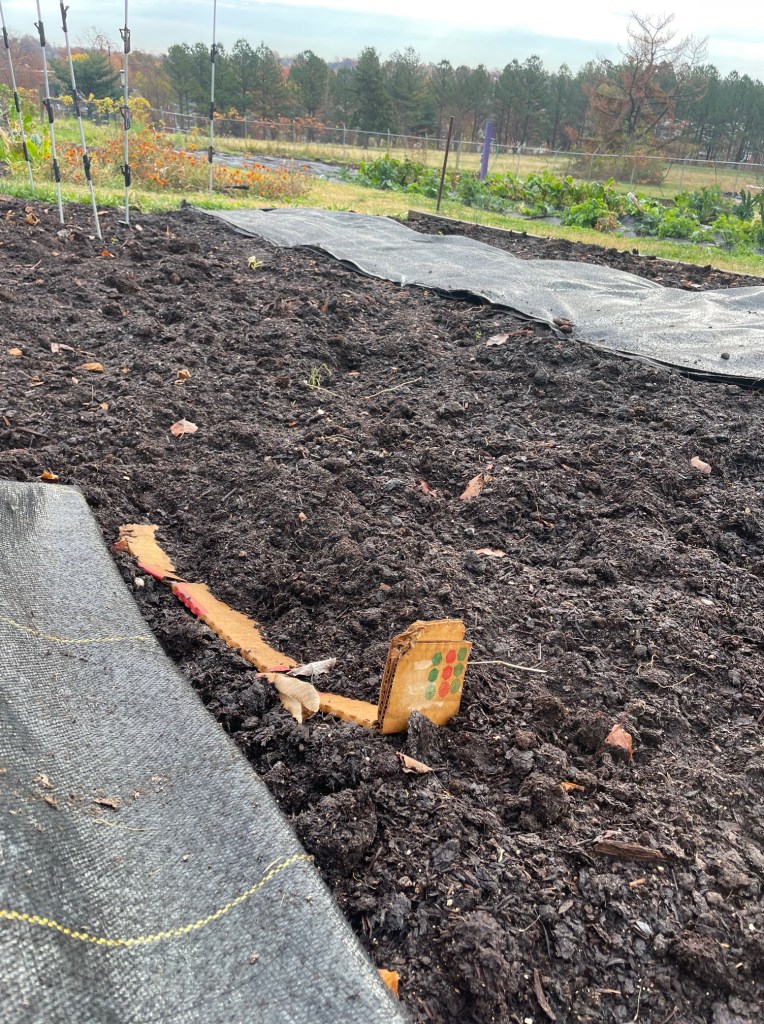
A few weeks before taking this photo of Francis and the cabbage, I was asked at the garden to put down cardboard, water it, and put a thin layer of dirt on top. I have used cardboard in gardens before to keep down weeds, and am a proponent of the use of it in gardens, but never in this fashion. Why waste water on the cardboard to weigh it down if the dirt is immediately being put on top? Why a thin layer of dirt which won’t be deep enough to allow plants to root? Why use cardboard with holes and non-environmentally friendly tape stuck to it? In frustration, I worked slowly so that I could ponder strong arguments for going about the project in a wiser way. I worked with a frown on my face, and eyebrows raised in perplexion.
It didn’t take me long to connect the cabbage with the frustrating task of the cardboard which took place only about twenty feet away. I realized I had failed. But the failure I felt was not so much in obedience (it was not a superior who was giving me the orders, and the task did get completed) but a failure in foolishness. I wanted to be efficient, wise, productive, and successful. Often the way of the Gospel, and the way of Francis, is seemingly the opposite. Living among the poor, and living poorly, is not often an efficient use of one’s resources. It’s often not wise to live in the “bad neighborhood”. It’s not productive to leave the 99 sheep in search of the one. Dying nailed to a cross is not usually deemed ‘successful’. Foolishness has a needed place not only in the Franciscan charism but also for anyone wishing to follow Christ.
 Kevin's Corner
Leave a comment